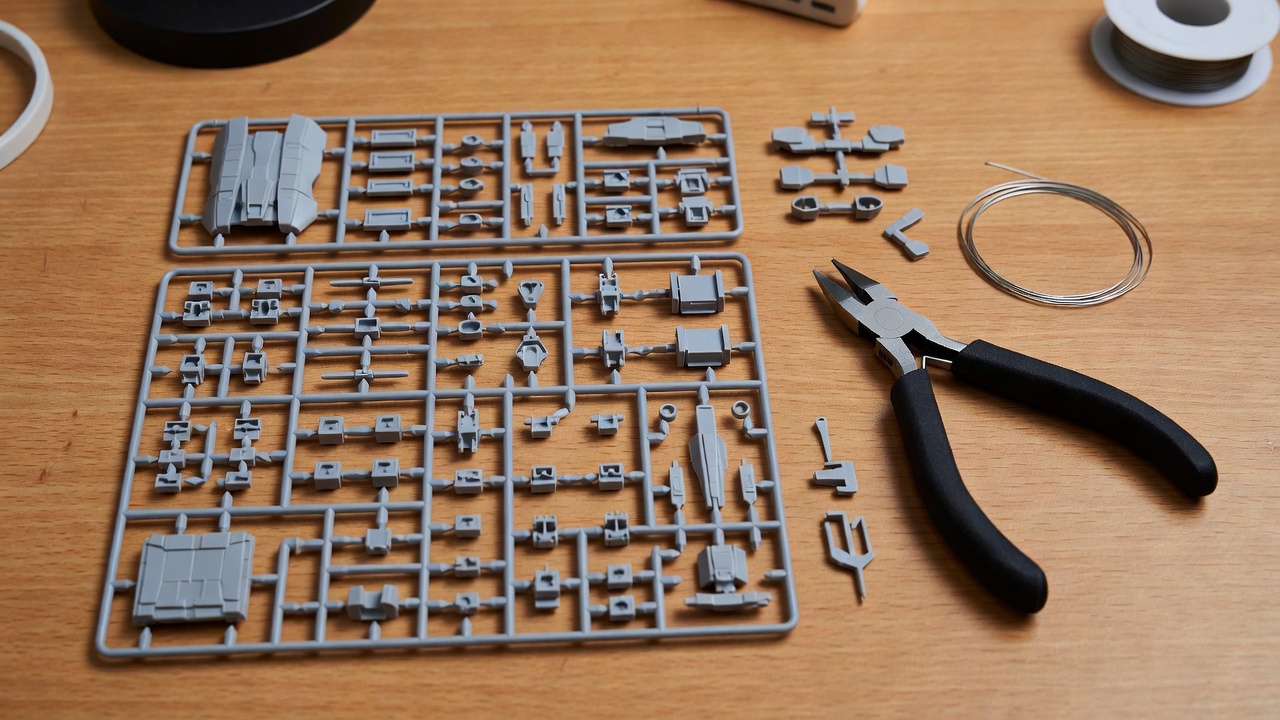
You need a pair of single-bladed hobby nippers, a hobby knife with replaceable blades, and fine-grit sanding sticks to cleanly remove polystyrene parts from their plastic runners. Using standard household scissors stresses the plastic and creates deep stress marks, whereas proper nippers cut flush with the gate, leaving minimal residue to be shaved down.
How does a snap-fit kit compare to a glue-required model?
Snap-fit kits, which dominate the Bandai Gunpla lines, utilize precision pegs and holes that hold the structure together entirely via friction without requiring any adhesive. Traditional scale models from manufacturers like Tamiya or Revell lack these internal friction pegs, requiring you to apply a liquid polystyrene cement that lightly melts and fuses the plastic seams together permanently.
How do you remove a nub mark properly?
You remove a nub mark by first cutting the part slightly away from the runner edge, leaving a small sliver of plastic attached, and then carefully shaving that excess down with a hobby knife. Once the nub is nearly flush, you use progressively finer sanding sticks, moving from 600-grit to 1000-grit and finishing with a polishing block, to restore the smooth surface of the plastic without gouging the part.
What is panel lining?
Panel lining is the process of applying a highly thinned, dark enamel wash or fine-tipped marker ink into the recessed grooves and structural seams of a model to create artificial shadows. You allow capillary action to draw the thin liquid along the panel lines, and once it dries, you wipe away any excess from the flat surfaces using a cotton swab lightly dampened with lighter fluid or enamel thinner, dramatically increasing the kit's visual depth.
How do you apply a water slide decal?
You apply a water slide decal by cutting it from the sheet, soaking it in warm water for about ten seconds until the thin film separates from the backing paper, and then sliding it directly onto the plastic surface using tweezers. You manipulate its final position with a damp cotton swab, and often apply decal setting solutions like Micro Set and Micro Sol to soften the film, ensuring it conforms tightly to curved armor parts or recessed panel lines.
Why apply a top coat to a finished model?
You apply a clear top coat to seal the plastic, protect delicate water slide decals from peeling, and alter the final sheen of the model to look less like raw toy plastic. A matte top coat diffuses light, hiding minor scratches from sanding and giving mechanical kits a heavier, realistic finish, while a gloss coat is used on scale model cars to replicate polished automotive paint.