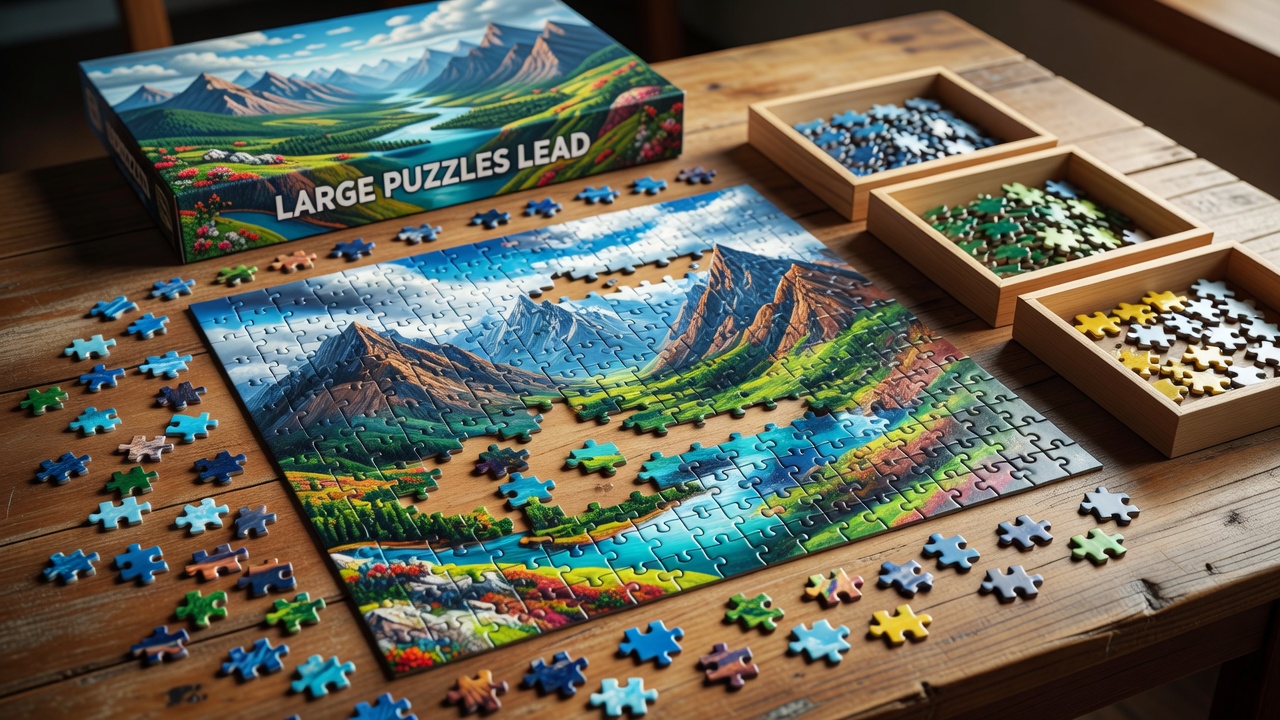
A large-format puzzle contains 1,000 or more pieces, requiring dedicated physical space and extended assembly time spanning several days or weeks. You tackle these puzzles not in a single sitting, but as an ongoing tactile project that demands spatial reasoning and methodical sorting.
How do ribbon-cut and random-cut puzzles differ?
Ribbon-cut puzzles, manufactured by brands like Ravensburger and Clementoni, feature pieces cut in a predictable, uniform grid where corners meet at intersecting lines. You contrast this with random-cut puzzles from brands like Cobble Hill or New York Puzzle Company, which use highly irregular, unpredictable shapes without a discernible grid pattern. You choose ribbon-cut for a methodical, predictable assembly rhythm, while random-cut challenges you to rely entirely on shape recognition rather than grid alignment.
How do you sort a 2,000-piece puzzle?
You sort a large puzzle by first isolating every piece containing a straight edge to form the border, then categorizing the remaining internal pieces into sorting trays based on distinct colors, textures, or text elements. When confronting large areas of identical color, such as open sky or dense forest, you separate pieces further by their shape type—grouping pieces with two knobs and two holes apart from those with three knobs or irregular edges.
What is the best surface for long-term puzzle assembly?
You build large puzzles on a specialized puzzle board or a dedicated puzzle mat, because a 1,000-piece puzzle typically requires a footprint of at least 70 by 50 centimeters. A rigid puzzle board with raised edges prevents pieces from falling and can be safely slid under a bed when not in use. You use roll-up felt mats for storage if rigid space is unavailable, though they often require minor piece readjustment upon unrolling.
How do you handle false fits?
You handle false fits—situations where a piece appears to lock perfectly into the wrong location—by inspecting the printed image alignment closely under bright, even lighting and checking the smoothness of the physical seam. In puzzles with large monochromatic sections, you rely on the subtle variations in knob and hole width to verify a fit, gently flipping the joined pieces to examine the structural alignment on the unprinted cardboard back.
How do you preserve a completed large puzzle?
You preserve a completed puzzle by applying dedicated puzzle glue or clear adhesive sheets to the finished surface to bind the pieces permanently. You pour liquid puzzle glue directly over the image, spreading it evenly into the seams with a plastic scraper, which dries clear and stabilizes the structure for framing. Alternatively, you carefully flip the completed puzzle between two rigid foam core boards and apply wide adhesive tape across the unprinted back to avoid altering the matte finish of the printed art.